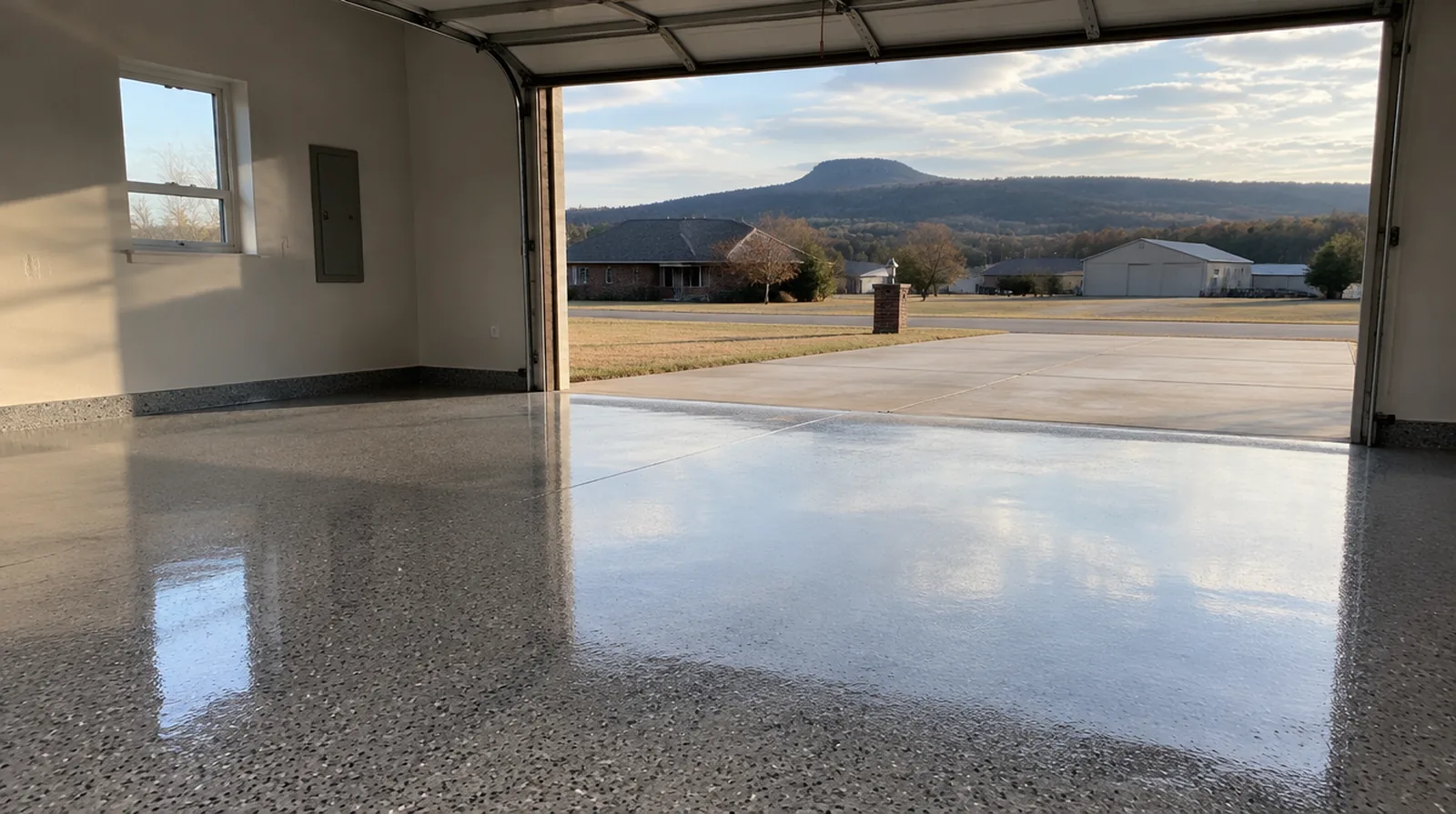
Who calls us in Poteau?
Most calls come from three kinds of floors. There are the garages on older houses in town, where the slab has decades of oil drips and a crack or two. There are the steel shop buildings out past the edge of town, where a pickup, a tractor, or a deer stand project shares the floor with a workbench. And there are small businesses along Broadway and the highway that need a floor customers see every day.
Each one needs something a little different, so we start by looking at the slab before we talk about colors.
What can go on a slab?
For a home garage
The standard choice is a ground and coated epoxy garage floor. Many people here add colored vinyl chips because red dirt and gravel dust hide better in a speckled finish.
For a shop building
Shops that see trucks, ATVs, and tools do well with a thicker build. When you can only spare a day, a quick-curing polyaspartic coating gets you back in faster. Businesses with heavier use can look at floors made for work spaces.
For a finish that shows off
A poured metallic floor works in a man cave or showroom. If you would rather keep plain concrete, a ground and polished slab has nothing to peel. We also fix coatings that are coming loose and seal porches and driveways.
For kitchens, cabin islands and bar tops, ask about epoxy countertops.
For a stained or worn drive, ask about our driveway coatings.
For backyard pools, ask about our pool deck coating.
For patios and outdoor kitchens, ask about our concrete patio coating.
What is hard on concrete around here?
- Humidity. Muggy summers in the Poteau River valley keep slabs damp, and moisture coming up from below is the top reason coatings blister.
- Storms and mud. Spring storms roll through LeFlore County and every truck that pulls in carries red clay with it.
- Cold snaps. Winter freezes are short but sharp, and the swings open up hairline cracks.
- Hard use. Shop floors here get grease, fuel, fertilizer, and dropped tools, not just a parked car.
How is a job priced?
We walk the floor, measure it, check for moisture, and look at any cracks or old paint. Then you get a single written number. Bigger floors cost more, a shop with heavy grease takes extra grinding, and a damp slab needs a vapor-blocking primer. Choosing chips or metallic over a solid color also changes the price. Nothing gets added later unless you ask for more work.
Do you come out to rural properties?
Yes. We work in Poteau, OK and on homes and shops outside town, including properties out toward Cavanal Hill. A long gravel drive is not a problem as long as we can get the grinder and vacuum to the building.
For general reading on air quality while coatings cure, the EPA explains VOCs here.
Poteau floor questions
Can you coat the floor of a metal shop building?
Yes, as long as there is a concrete slab. Shop slabs are often rougher and more stained than garage slabs, so we plan for extra grinding.
My slab gets damp in summer. Is that a deal breaker?
Not usually. We test it, and if it reads high we use a primer built to hold back moisture before the color coat goes on.
Will the red dirt stain it?
Once sealed, the clay sits on top and washes off with a hose or mop. A chip finish hides it between cleanings.
How long will I be out of the garage?
Usually one to three days depending on the system. Polyaspartic is the fastest.
Starting with a look at your slab and your lot
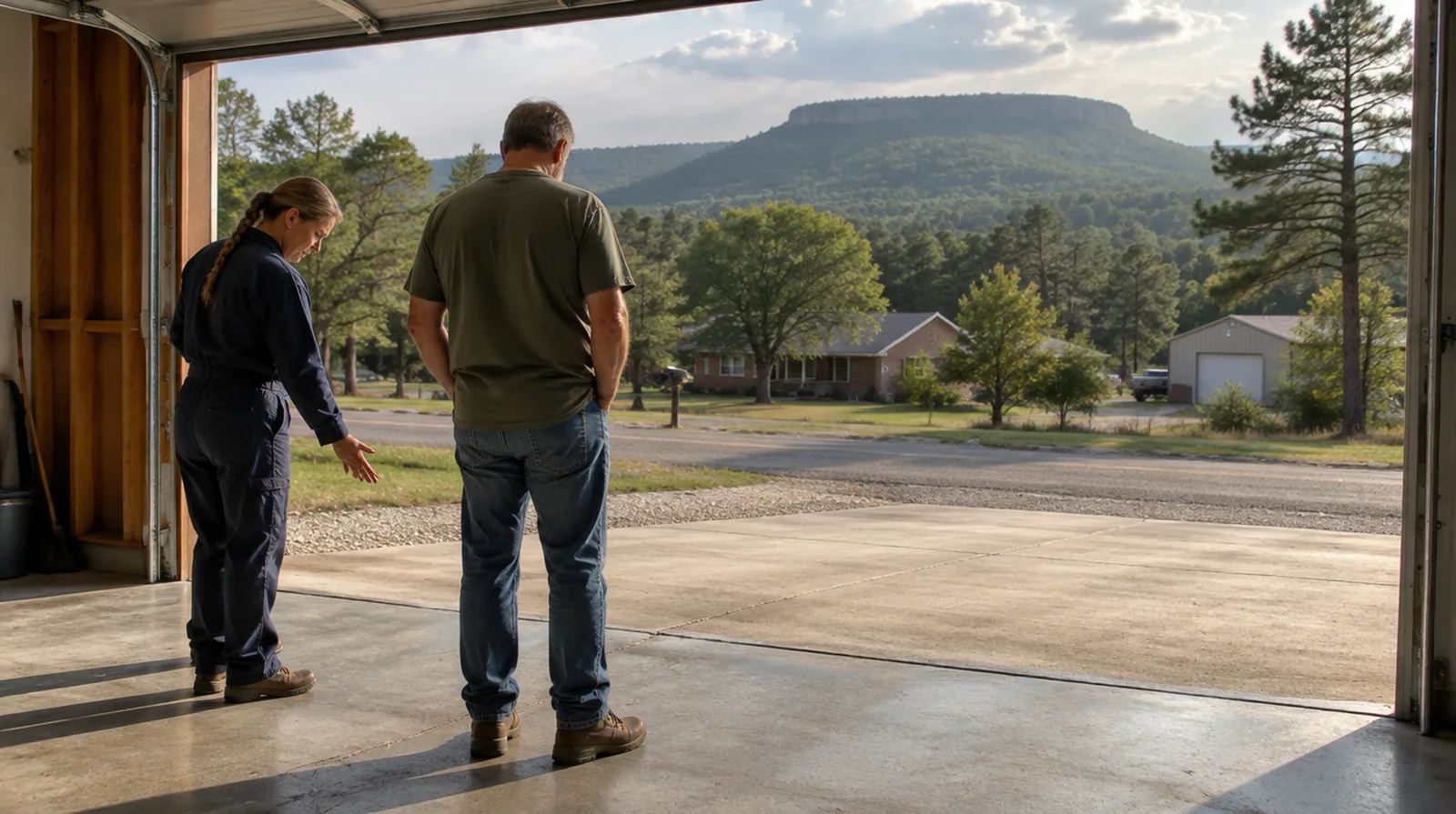
Most of our Poteau jobs begin the same way: we stand in the open garage door with the owner and look at the floor together, the way it is happening in the photo. Behind a lot of these houses, the land rises into wooded ridges, and that slope tells us a lot about the slab. Water coming off the hill can run under the garage door or soak the ground beside the foundation, and a slab that stays damp needs a different primer than one that sits high and dry. We take a moisture reading, look for hairline cracks running toward the low corner and ask how often you see standing water after a heavy rain.
From there we can talk about what you want from the floor. Some people want a tough chip floor for a truck and a deep freezer. Others are finishing a shop behind the house or a room at a cabin near Lake Wister. Knowing the use and the slab together keeps us from selling you more coating than you need.
Towns and roads we cover from Poteau
LeFlore County is long and mostly rural, and a lot of our work is out past the city limits. We take jobs in Heavener, Spiro, Wister, Howe, Panama and Shady Point, and on the county roads in between. If your property is down a gravel drive or up a hill, let us know when you call. We will plan the trailer, the grinder and the generator if there is no power in the building yet.
Rural shops often have slabs that were poured quickly to get a roof over equipment. Those floors can have rough spots, low areas that hold water, and thick oil stains from years of tractor and truck work. We can grind and patch most of that before coating.
What to have ready before your appointment
- A rough idea of the space size, or let us measure on site.
- A list of what is stored or parked there, including anything heavy.
- Any old paint or coating history you know about.
- Photos of trouble spots, like cracks, stains or areas that stay wet.
A couple more questions we hear in Poteau
Can you work at a cabin with no one living there?
Yes. Many owners meet us for the first visit and then leave a key or door code for the install days.
Do you need power in the building?
It helps, but we can bring a generator for buildings without service yet.
Want to see what your slab needs?
Call (918) 201-9962 or use the form to set up a free estimate on your floor.